What is Internal Work in Pelvic Floor Therapy
Internal exam and treatment in pelvic floor therapy — What is it, what to expect, and is it necessary?
Assessment and treatment of the pelvic floor muscles may involve directly observing, palpating, and providing therapy to the pelvic floor muscles themselves. Some therapists may have different techniques or approaches. At Anxious Pelvis Clinic, we use additional training in trauma-informed care and take a consent forward, nervous system supportive approach.
We have opportunity to observe and palpate these muscles externally or internally (pictures below). Internal can be done vaginally or rectally.
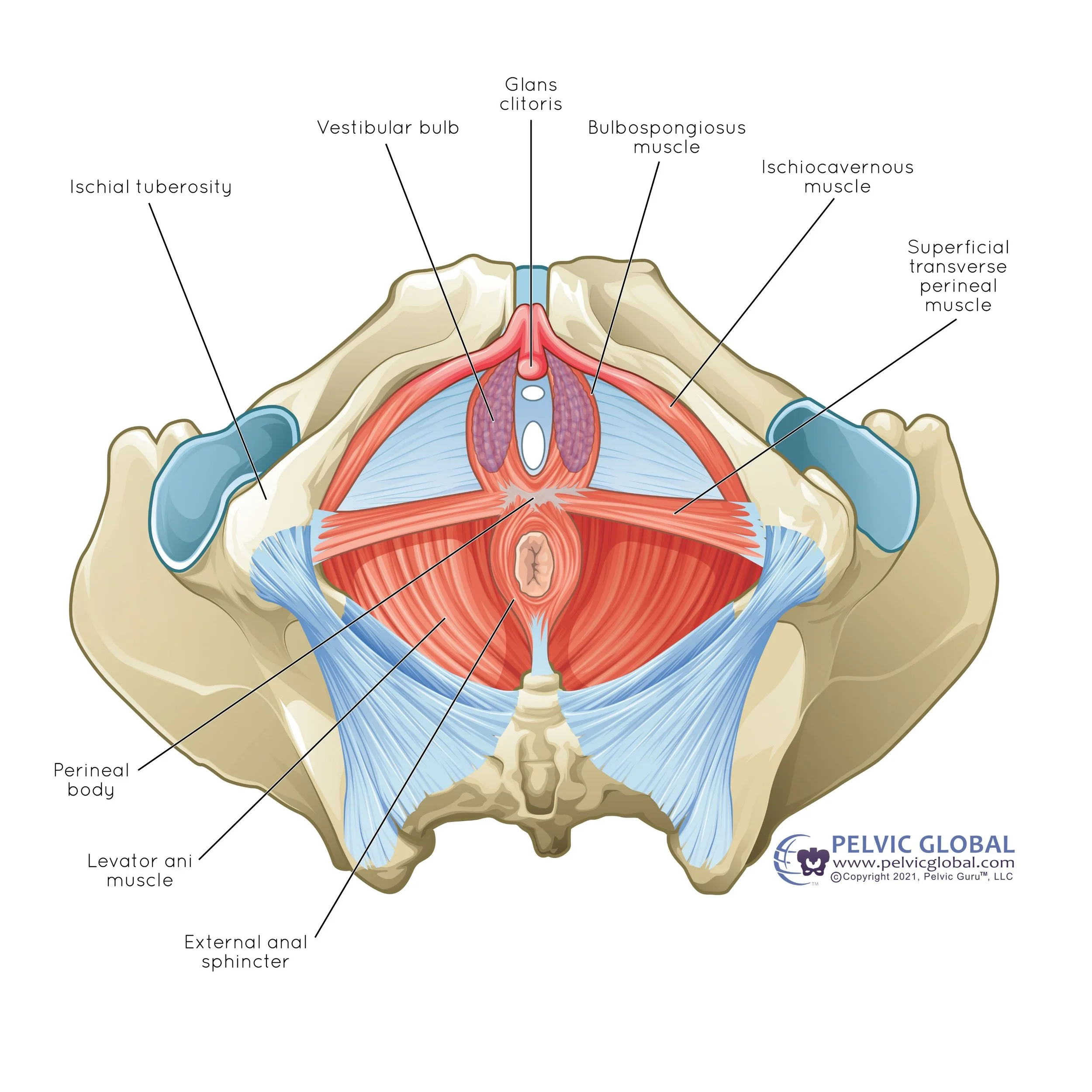
These are some of the muscles that we are assessing and treating externally.
Image used with permission from Pelvic Guru®, LLC as a Pelvic Global Member.
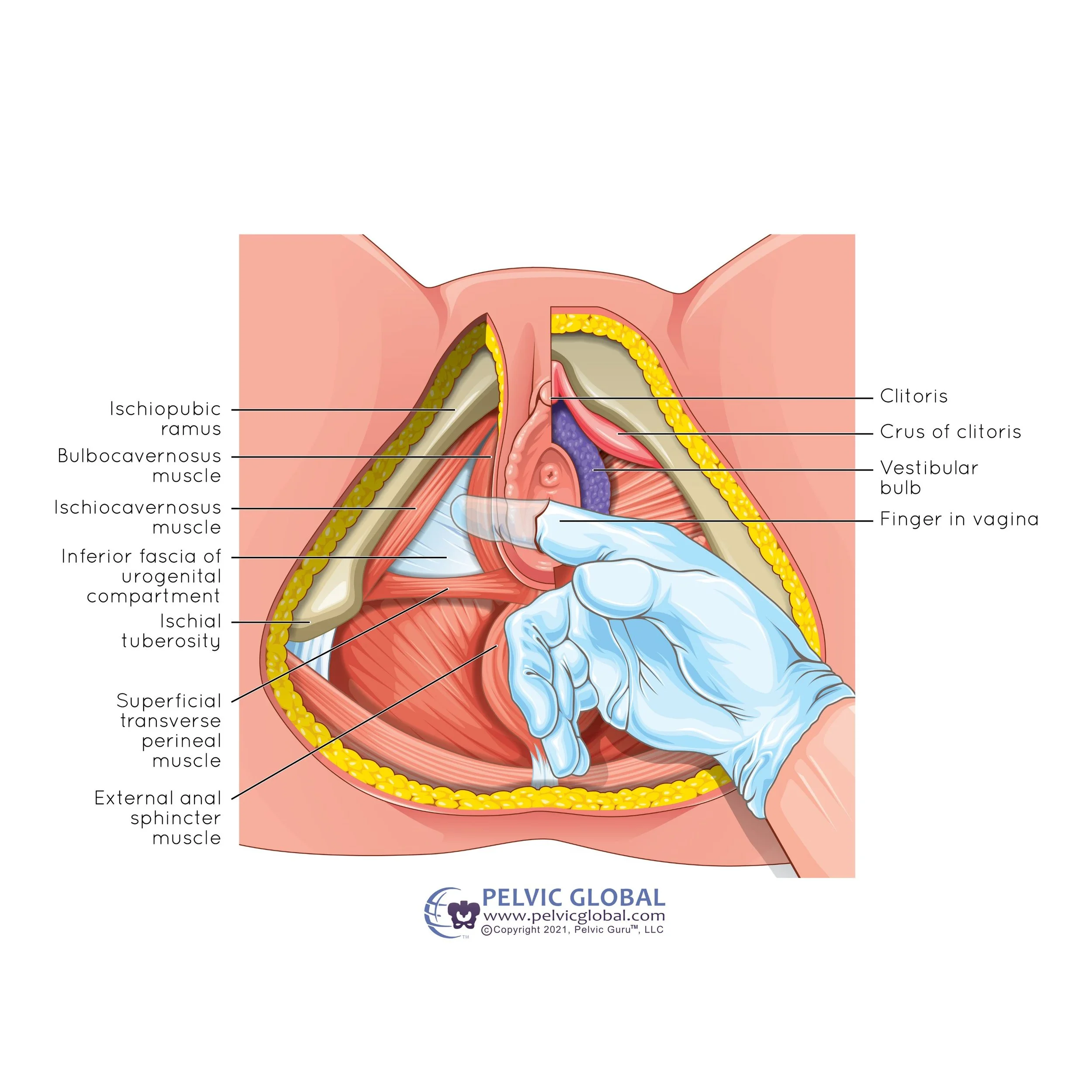
This is a view of the muscles during internal therapy, you can see the gloved finger inserted and palpating the muscles on the right side of the pelvic floor.
Image used with permission from Pelvic Guru®, LLC as a Pelvic Global Member
Preparation for Internal Assessment and Treatment:
I understand pelvic floor exams can feel vulnerable. Prior to an exam, we will walk though what it will look like and answer any questions you have. If you are fully consenting to an exam, your therapist will exit the room, you’ll then get underdressed waist down, and lie underneath of the sheet. Your therapist will then walk back into the room. Prior to exam, I prefer to “warm up” with breath or abdominal work as applicable. We will also ensure that sensory experiences in the room, such as lighting or music feel supportive.
For the exam, it is often done in a butterfly position. A pillow will be under one leg, and your therapist sitting on the side of the table at the other leg. Consent will continue to be obtained throughout the entire process.
Additionally, this process can be altered in a way that makes you feel more comfortable. For example, you’re welcome to keep underwear on for trigger point of external pelvic floor muscles if you prefer. You could also choose that you perform the touch while your therapist guides you through it. Together, we can create adaptations that work for you.
Assessment - What is an Internal Exam?
Whether externally or internally, some things we may be looking at are:
Tissue Quality and Skin Quality — Basically this is if there is anything to note about the skin externally or tissue internally. This can be redness, irritation, hives, micro-tears, anything of that nature.
Coordination & Pressure Management — We can directly observe and feel how your muscles are coordinating with the rest of your body during breath, contraction, core activation, coughing or high pressure activities and more.
Sensation — We can assess if there is numbness or pain on any particular muscle points. We’re observing both what do you notice with different touch or in different areas, and what the therapist is feeling in those areas.
This can be with application of a finger, a pelvic floor tool (if you have one and bring it in for that session), or a q-tip (the q-tip exam is usually around the vestibule — which is the external area between the inner folds surrounding the vagina and urethral area).
Strength & Endurance — Along with coordination, we can observe the strength & coordination of your contraction, and how exactly those muscles are recruiting. We can also observe this in isolation or during functional activity.
Tension & Tone — This is both observed by the therapist and your sensation of the touch/pressure. For some of you, the pelvic floor muscles may feel closed off to where it limits insertion completely. Know that insertion would NEVER be forced. (see more on this below)
Pelvic Organ Positioning — We may assess for any prolapse and/or how the tissues and organs respond during times of pressure.
Body Response — The body may respond with certain emotions, sensations, or muscle reactions. This is observed and approached with trauma informed care.
What is Internal Trigger Point Therapy?
Trigger point release is a form of manual therapy to release tension or tender points in the muscles. With both the external muscles and internal:
Gentle pressure is applied
We check in on the sensations
You may then engage in diaphragmatic breath, awareness techniques, or pain reprocessing techniques. All of these would be explained and trained prior to treatment and therapist guided as we went along.
Other manual methods may be performed guided by therapist
Then we move onto the next spot!
Trigger point release is also a time to be communicating with your brain and nervous system. You’re retraining the response to pressure on those muscles.
What Else Happens During Internal Pelvic Floor Treatment?
Outside of trigger point release, internal treatments can consist of:
Fascia release
Scar tissue mobilization
Coordination training
Awareness training and body connection strategies
Nervous system regulation
Pelvic tool training, such as:
Pelvic wands
Pain reprocessing
Nerve mobilizations
“Do I Have To Do Internal Pelvic Floor Therapy?”
You never have to do internal pelvic floor therapy. Let me say that again, internal work is NEVER required.
The goal is not for the therapist to be “doing something TO you”. It’s done WITH you, and with your body’s full consent. If the body’s not consenting, that would show up in your muscles and body response. Outside of not respecting your consent, it wouldn’t even serve for productive treatment.
Internal work is a whole body treatment, the brain is involved every step of the way.
Internal assessment and treatment can be very valuable, but that does not mean that it’s necessary.
Sometimes your body experiencing regulation, shame reduction, and autonomy can be enough to feel an impact on your symptoms. As mentioned earlier, there are also always ways that we can adapt the approaches to work better for you. As an experienced therapist, I can also often gather what is likely going on without always directly seeing it or feeling it through internal exam. At Anxious Pelvis, we practice under a model that supports YOU…your body, your nervous system, your consent, your values, your goals…not what makes insurance happy.
We understand the vulnerability that comes with this work, which is why we take it seriously.